
Agentic AI12 min read
Agentic AI Revolution in Manufacturing
Why the future of manufacturing intelligence is a coordinated team of specialized agents working together.
Read more
Operational teams spend hours hunting for answers across dashboards. Rishi delivers instant, accurate insights through specialized agents, RAG, and guardrails built for manufacturing precision.

Every day, operational teams face the same frustrating reality: the knowledge they need exists, but finding it is a time-consuming nightmare. Plant managers, process engineers, and quality analysts spend hours hunting for answers across:
The core problem: Knowledge exists, but it's scattered across systems, formats, and interfaces. Getting answers is slow, tedious, and error-prone. GenAI promised instant insights—but pure LLMs aren't built for structured data, manufacturing semantics, or analytics precision.
Rishi was built specifically to close this gap.
Every plant asks variations of the same questions:
A generic LLM cannot answer these questions reliably. Here's why:
Cycle time scatter? PID controller logs? Weld signals? LLMs hallucinate when forced into analytical reasoning with numerical data. They can describe patterns but cannot compute them accurately.
Stations, rework loops, buffer logic, upstream/downstream relationships—these manufacturing concepts are not in generic LLM training data. They lack the domain knowledge needed for contextual understanding.
Ask ChatGPT to "pull downtime data, correlate with stop events, and group by SKU"—and it invents outputs. It cannot actually execute queries or access real production systems.
It can describe a graph, but cannot produce a correct one without structured context and validation. There's no connection between the LLM's output and actual production metrics.
LLMs can talk, but manufacturing needs AI that thinks, computes, retrieves, correlates, and guarantees correctness.
Rishi acts as a single intelligent layer over all your production data:
Raw machine data
Structured historian signals
Industrial platform events
Shift logs and manuals
Users no longer jump between dashboards. They simply ask: "Rishi, what's the root cause of yesterday's downtime on Line 4?"
What once took hours now takes seconds.
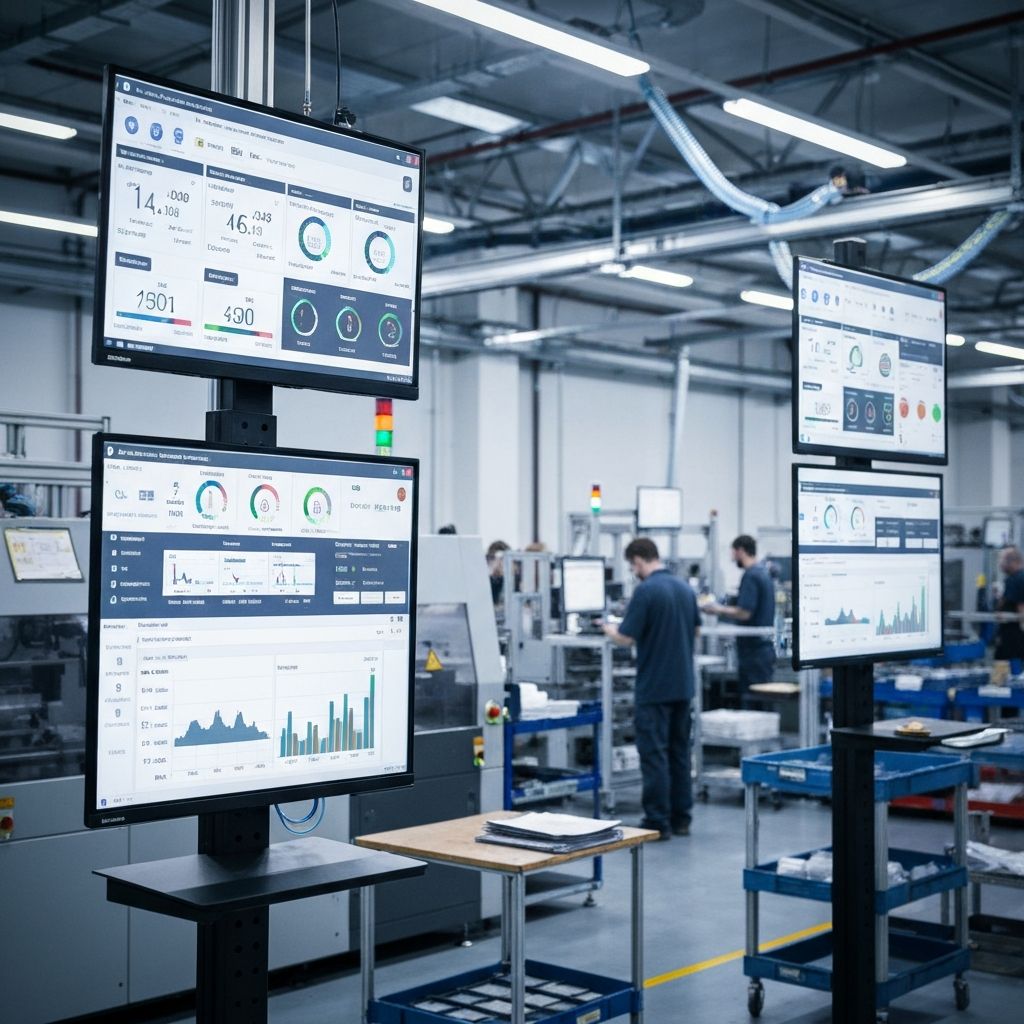
Rishi orchestrates a hierarchy of specialized agents, each expert in their domain:
Understands stoppage patterns, OEE loss, and root-cause trees
Inspects FPY, defect clusters, and SPC drift patterns
Models takt time, bottlenecks, and WIP distribution
Identifies cycle-time deviations and tool wear signatures
Generates SQL and Python for custom reports
Builds graphs, dashboards, and data exports
A Supervisor Agent routes requests, validates steps, and ensures correctness. This structure prevents hallucinations and ensures every answer is grounded in domain-specific logic.
Rishi uses the ReAct (Reason + Act) framework so the system operates deterministically:
Identifies what data or tool it needs for the query
Queries pipelines, executes code, retrieves tables
Interprets actual numbers from real data
Provides grounded answer with charts and exportable datasets
Pure LLM:
Hallucinates a generic response
Rishi:
This is AI that performs, not invents.
Rishi retrieves from multiple structured and unstructured sources:
Result: Factual accuracy, deterministic data retrieval, and zero hallucinated numbers.
Rishi uses LangGraph to orchestrate complex workflows:
End result: A resilient, fault-tolerant AI system designed for industrial-grade reliability.
Rishi embeds guardrails at every layer to ensure data integrity and output accuracy:
Ensures data structures match expected formats
No negative cycle times or impossible values
All critical data points must be present
Agents only access authorized tools
System validates its own outputs before delivery
Transparency about certainty levels
Multiple agents confirm critical findings
Final reasoning checks by supervisor agent
If data is missing or uncertain, Rishi doesn't "guess"—it alerts the user with context about what's needed.
One natural-language question → one correct answer. No dashboard hunting.
Cycle-time plots, downtime Pareto, heatmaps, throughput curves—all AI-generated.
Rishi produces SQL, Python, or scripts to accelerate engineering tasks.
Tailored dashboards for specific questions, not generic templates.
CSV exports, shift reports, KPI summaries, and correlation datasets on demand.
Built to handle millions of OT datapoints per hour with optimized query performance.
"FPY can drop due to operator training, machine failures, material issues..."
→ Useless. Generic. Fabricated.
→ Correct. Actionable. Data-backed.
This is the future of operational intelligence.
Manufacturing teams don't need more dashboards, more spreadsheets, or more reports. They need one place to ask a question and get a correct, data-backed answer instantly.
Rishi delivers that through a multi-model, agent-driven, guardrailed AI architecture that understands the physics, logic, and data structures of real factories—not hypothetical ones.
Rishi isn't a chatbot.
Rishi is an AI-native operational partner for production lines.
Generic LLMs can chat but cannot access, compute, or validate manufacturing data. Rishi uses specialized agents, RAG for data retrieval, ReAct for deterministic workflows, and guardrails to ensure every answer is grounded in real production data with zero hallucinations.
Rishi handles structured time-series data, historian signals, industrial platform events, PLC logs, semi-structured shift logs, unstructured manuals and SOPs, and millions of OT datapoints per hour through optimized data pipelines.
Rishi embeds guardrails at every layer including schema validation, data range checks, required field enforcement, self-critique loops, confidence scoring, cross-model verification, and supervisor agent validation. If data is missing, Rishi alerts the user instead of guessing.
Yes. Rishi's Data Engineering Agent can generate SQL and Python code for custom reports, while the Visualization Agent builds tailored dashboards, graphs, and data exports (CSV, shift reports, KPI summaries) based on your specific questions.
ReAct (Reason + Act) is a framework that makes Rishi deterministic rather than<bos>-is-probabilistic. It reasons about what data is needed, acts by querying systems and executing code, reasons again with actual data, and generates grounded answers. This turns guesses into verified results.
What previously took hours of dashboard hunting and manual correlation now takes seconds. Rishi retrieves relevant data, performs analysis, correlates patterns, generates visualizations, and delivers actionable insights in real-time.
Specialized agents (Downtime, Quality, Throughput, Process-Drift, Data Engineering, Visualization) are domain experts focused on specific manufacturing challenges. A Supervisor Agent coordinates them to solve complex problems that require multiple types of expertise, preventing the generic responses typical of single-model systems.
Yes. Rishi's data pipeline is built for industrial scale, handling millions of OT datapoints per hour with scalable ingestion, intelligent semantic modeling, schema-aware time-series storage, and optimized query performance for fast, accurate responses.
Head of Product
Atul is a seasoned product leader with deep experience in manufacturing and technology. He has built and scaled innovative SaaS products into multi-million dollar businesses through data-driven decision-making and a strong focus on customer needs, consistently delivering successful launches and significant business impact.
Why the future of manufacturing intelligence is a coordinated team of specialized agents working together.
Why the future of manufacturing intelligence requires moving beyond embedded AI to AI-native systems.
Operational teams spend hours jumping between dashboards. Rishi transforms this chaos into instant, accurate answers.
See how natural language AI is transforming manufacturing operations at leading plants worldwide.
Try Rishi Platform